The Orphean Condition
An Ancient Love in Looking Back

Orpheus, the supreme musician in Greek mythology was born of Calliope and Apollo. He received a golden lyre as a gift from Apollo as a child and it was the god who taught him how to play it extraordinarily. His mother, a Muse, showed him how to add verses to his music and his eight aunts taught him how to perfect them. This skilled young man became the greatest musician who ever lived, and while beloved by many, he loved only Eurydice.
Orpheus and Eurydice were deeply in love. Hymen, the Greek god of marriage was to wed them. Yet, on that joyous day, he was not at his best. He forgot to bless the couple, probably as an ominous foreshadow of the future of the newly weds.
Soon after the marriage, Eurydice suffered a snake bite. The encounter was fatal. She died and her soul instantly descended into the underworld.
When Orpheus found the body of his one true love, he mourned her death so deeply that his grief touched the hearts of the gods. Apollo himself suggested that he travel to the kingdom of the dead and ask for his wife’s soul back.
Orpheus headed to a passage to the underworld singing this song:
O deities of this dark world beneath the earth,
I come not down here because of curiosity to see the glooms of Tartarus:
I have come, because my darling wife stepped on a viper that sent through her veins death-poison, cutting off her coming years.
You may not know Love down here, but I do:
by this Place of Fear, this huge void and these vast and silent realms, renew the life-thread of my loving Eurydice!
After all, one day, when grey and old and full of age, she shall be yours yet again and forevermore.
All I ask of you is just a few years of her life as a boon.
But if the fates deny to me this prayer, then I do not want to go back,
and may you triumph in the death of two!
The song of Orpheus charmed many, it is said that even Sisyphus could be seen sitting idly on his stone and unconscious and inanimate objects were moved. Hades and Persephone were so moved that they could not refuse his pleas. They allowed Orpheus to take his wife back to earth on the condition that he should not look back at her until both of them regain the light of the sun.
He took the journey.
Orpheus, armed only with Hades’ word that Eurydice was behind him, and the full knowledge that no man was ever allowed to visit the underworld, turned his eyes to gaze upon his wife. In an instant, she vanished, and the air was all Orpheus could feel between his arms as he stretched them out, eager to embrace and rescue the love of his life. A moment later, the walls of the underworld echoed a whispered and sorrowful “farewell” and then there was only silence and despair.
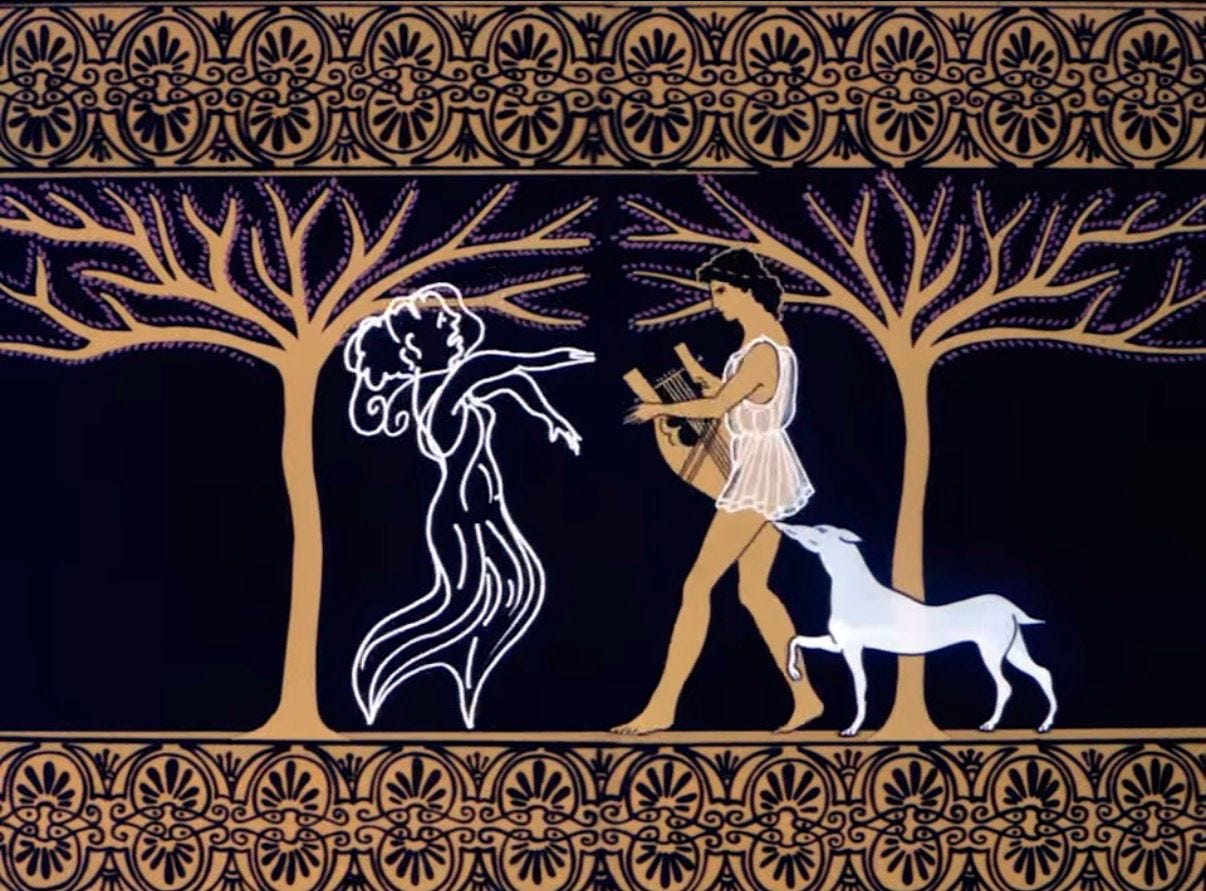
This tale is especially tragic when you see yourself as the grief stricken Orpheus, whose love has no bounds. The conviction with which he searches for his wife, the lengths to which he will go to see her again. The anxiety with which he does as he is told, hoping Eurydice is with him. At this critical moment, the decision to look back, which is just as frustrating to witness now as it was the first time the story was told. The devastation in this blameless sin. If you truly see yourself in Orpheus, you must understand why he turned back.
The Human Condition is longing.
The heart often wins battles of the mind because in loving someone, there will always be residue. In Orfeo ed Euridice, a reimagining in opera composed by Christoph Willibald Gluck, we get a glimpse into the minds of the lovers. In this version, Eurydice is unaware that Orpheus is forbidden from looking back, the condition was that he cannot tell her. Here, she assumes that he does not love her anymore. He cannot bear it. In this version, Orpheus turns back as reassurance, to prove to her that she is loved. In this version, he turns because he loves her and cannot stomach the idea of her thinking that he doesn’t.
The habit of love is worrying. In most versions of this tale, Eurydice stumbles as she follows Orpheus out of the underworld. Orpheus hears a scuffle and turns, to his wife’s demise. In other versions, he cannot hear Eurydice behind him. As he travels the underworld he fears that he has been tricked. Of course he looks. The Human Condition is to look. We search for evidence that we are loved by those we love deeply. We stare at the ‘I’s in I love you too’s, we examine their faces, we ask friends of friends what they said about us, we ask them how they feel. This searching does not cease. One must view themselves as closest to Orpheus when they stalk their ex’s Instagram at night, when their ears perk up at the mention of a former friend’s current life. The love, with all its relentless curiosities, never stops asking questions.
We are Orpheus, in our hoping. In hearing this tale, over and over. In seeing it through to the end, hoping that this is the time he will not turn, that the lovers make it back to earth and are reunited. We cling to hope this way, it is The Human Condition. To want something very badly, and to hope in its favour despite its inevitability. The heart persists. Despite. And seemingly, always.
The myth of Orpheus and Eurydice, then, does not stand as a caution against the consequences of doubt but a testament of The Human Condition of love.
“Eurydice, dying now a second time, uttered no complaint against her husband. What was there to complain of, but that she had been loved?”
—Ovid, Metamorphoses
Very good illustrations Vee. Apollo sired some very interesting children. I'll say that much.
Another great sermon from an evangelist of love 👏🏾
Loved this!